
Marketing Strategy Development for Growing Businesses
You have a website. Social media. Maybe email, advertising, events or an agency helping you execute. But is there a strategy connecting all of it to how your business actually grows?

You can be doing a lot of marketing and still be missing the strategy.
This work is designed for businesses that are not starting from zero.
You may already have customers, marketing history, data, vendors, campaigns, an internal team or several channels in motion.
-
Marketing has grown one tactic, platform or vendor at a time.
Different people are making decisions within their own areas without one shared strategic direction.
You have several products, services, customer groups or opportunities competing for attention.
You know there is room to grow, but you're not sure which opportunities deserve investment.
Your team can execute, but you're questioning what they should actually be executing against.
Marketing decisions are often influenced by what's urgent, trending or presented to you next.
You're preparing for another stage of growth and know the way you've been marketing can't continue on autopilot.
You need to know which ideas belong in the strategy in the first place.
I don’t start with channels. I start with your business.
Those can all be reasonable questions, but I don’t start here.
Before recommending another marketing investment, I need to understand what the business is trying to accomplish, what is happening today, where meaningful opportunities may exist, and what marketing actually needs to help move forward.
Sometimes that leads to advertising. Sometimes email. Sometimes a different customer audience. Sometimes a stronger customer journey. Sometimes a marketing activity you're already doing deserves significantly more attention.
And sometimes something you've assumed you “need” doesn't belong in the strategy at all.
The business goal comes first. Marketing supports it.
Knowing who buys from you isn’t the same as having an audience strategy.
This is one of the biggest gaps I find when talking with business owners.
Most can tell me who they serve.
“We work with small businesses.”
“We serve homeowners.”
“Our customers are families.”
That's useful. But there's a significant difference between being able to describe your customers and understanding them deeply enough to make strategic marketing decisions around them.

A strong audience strategy can reveal that customers you've grouped together actually behave very differently.
Or that a smaller customer group deserves far more attention than its size initially suggests.
Or that an audience already buying from you represents an underdeveloped growth opportunity.
And those distinctions can change your messaging, acquisition strategy, customer experience, channel decisions, offers and where you invest next.
-
Imagine a business notices that one small group of customers consistently makes unusually large purchases.
On the surface, they chalk it up to a type of customer they occasionally serve.
Strategically, it could represent something much bigger: a distinct audience with different needs, buying behavior and revenue potential that deserves its own growth approach.
That's the difference.
Audience strategy is about understanding which customers matter, what makes them different, and what those differences mean for growth.
Strategy connects the pieces.
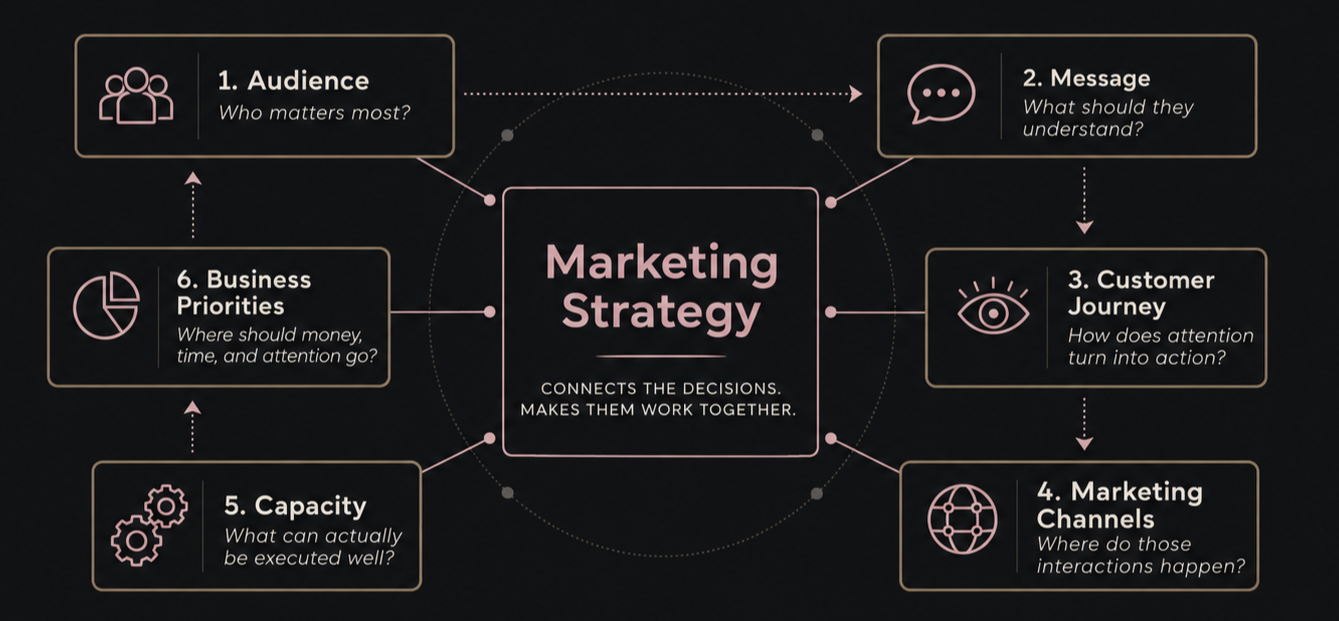
The hardest and most important work in marketing is determining how everything should relate.
Your audience influences your message. Your message influences whether someone pays attention. Your customer journey influences whether that attention turns into action.
Your marketing channels influence where and how those interactions happen. Your capacity influences what can actually be executed well.
And your business priorities should influence where the money, time and attention go.

THE ENGAGEMENT
Marketing Strategy Development
Marketing Strategy Development is The McKnight Element's comprehensive strategy engagement for established businesses that need more than another campaign, channel recommendation or marketing plan.
Over a minimum of 12 weeks, I work with you to understand the business behind the marketing, investigate the audiences and opportunities that matter, analyze what the available evidence is telling us, and develop a documented marketing strategy your leadership, team and marketing partners can execute against.
Your business determines what the strategy needs, not a predetermined template.
WHAT YOUR MARKETING STRATEGY WILL DEFINE
Every business requires a different investigation. The depth and emphasis of these areas will vary, but these are the core strategic decisions the engagement is designed to solve.
-
We'll establish what the business is trying to accomplish, where strong opportunities may exist and what marketing needs to support.
-
We'll determine which customer groups matter most, how they differ, what influences their decisions and where underdeveloped opportunities may exist.
-
We'll establish what the market needs to understand about the business, what differentiates it and how messaging may need to shift across priority audiences.
-
We'll examine how customers discover, evaluate, choose, return to and deepen their relationship with the business, and identify where marketing can strengthen that journey.
-
We'll determine the role of channels, campaigns, content, paid media, email, partnerships and other marketing activity based on what the strategy actually requires.
-
We'll determine how progress should be evaluated, what deserves attention first, what can wait, and how the strategy should be sequenced against the business' actual resources and capacity.

HOW WE’LL GET THERE
Phase 1: Discover
Understand the business, objectives, customers, marketing history, existing resources and the environment the strategy needs to work within.
Phase 2: Investigate & Analyze
Examine the available evidence, research the questions that matter and identify relevant patterns, gaps and opportunities.
Phase 3: Develop the Strategy
Turn what we’ve learned into connected strategic direction across the areas the business actually needs.
Phase 4: Implementation Advisory & Oversight
During the final phase of the engagement, I stay involved as the strategy begins moving into implementation by providing strategic guidance, reviewing decisions, helping maintain alignment and advising the people responsible for carrying the work forward.
Your team, agency or specialists execute the work. I help make sure implementation remains connected to the strategy we built.
YOU’LL LEAVE FEELING…
Like the noise has finally quieted. You’ll understand what’s actually happening in your marketing, what matters most, what can stop competing for your attention, and what needs to happen next. Instead of carrying a dozen disconnected ideas, opinions and unanswered questions, you’ll have a strategy you can explain, defend and act on with far more confidence in where your time, money and team should go. That clarity creates relief: less second-guessing, less wasted motion, and a much stronger sense that your marketing finally has a direction.
Marketing Strategy Development starts at $9,449.
Engagements begin at 12 weeks and might extend to 16 weeks depending on the complexity of the business, research requirements, available data and strategic scope.
Complimentary. You don’t need to know exactly what your business needs before we talk.
What Clients Say
-
![Man in front of a wooeden background, smiling, wearing a white button down shirt]()
“I really enjoyed working with Elaine! She’s incredibly thoughtful in how she approaches strategy and does a great job breaking things down in a way that actually makes sense. She helped us set up our audiences, get our ads up and running, and gave us a strong foundation to build from. Would definitely recommend her to anyone looking for smart strategic support!”
- Austin M., CEO @ Theory Real Estate
-
![Manager's Pizza logo]()
“…What impressed me most was the process. Every meeting was well organized, collaborative, and focused on creating practical solutions we could actually implement. Not just give generic marketing advice—Elaine helped connect the dots between our brand, customer experience, community outreach, and long-term growth strategy…”
- Raveen K., Owner of Manager’s Pizza
-
![Capital letter E on a white background]()
“Elaine is absolutely incredible and talented in many ways. She helped my team and me arrive exactly where we needed. The steps were clearly outlined, and she was very communicative throughout the whole process. She was knowledgeable and fun to work with. We would absolutely work with Elaine again! Truly a gem.”
- Emily W., Namchak
-
![Leslie Davenport]()
“I booked one hour with the McKnight Element not sure what to expect, and left feeling like I'd had a full check-up for my business. She quickly identified what wasn't working and why, offered a clear and doable plan, and gave me genuine confidence about what to do next. She's like a marketing doctor — diagnosis, treatment, and cure! I felt so much better after the appointment. I'll definitely be back when I need a boost. Highly recommended.”
- Leslie Davenport, Author of All The Feelings Under the Sun
-
![a woman wearing a jean jacket over a black shirt, smiling, with gray stone background]()
“Working with The McKnight Element exceeded every expectation I had. Elaine's marketing strategy was comprehensive, creative, and thoughtful, covering far more ground than I would have imagined on my own. She took the time to understand my goals, offered actionable ideas tailored to my situation, and provided a clear roadmap that made the entire process feel manageable. If you're looking for someone who combines expertise, creativity, and genuine investment in your success, I highly recommend The McKnight Element.”
- Erica S., Author of Dead Things




Marketing strategy can sound like a big, abstract thing.
It shouldn't.
At the end of the day, we're making decisions about actual people, actual resources and actual business goals. The complexity is about knowing what deserves investigation, seeing connections that aren't immediately obvious and making good decisions from what we uncover.
You need to know your business. I'll bring the marketing lens.

A quick note from the element:
Have one marketing decision you need to work through?
Sometimes you have one specific challenge, opportunity or decision and want to talk with an experienced marketing strategist in the room with you.
That’s what the 60-Minute Strategic Consulting Session is for. We’ll spend the hour working through it together.
Note: This is a focused strategic working session, not a substitute for the comprehensive Marketing Strategy Development.
Frequently Asked Questions
-
A marketing strategy establishes how marketing will support specific business objectives.
It provides direction around areas such as audiences, positioning, customer journey, growth opportunities, marketing channels, priorities and measurement so marketing decisions work together instead of being made one tactic at a time.
-
A marketing strategy establishes the direction and reasoning behind the marketing.
A marketing plan translates that strategy into specific activities, timelines and responsibilities.
In other words: Strategy determines what matters and why. The plan organizes how it gets done.
-
Yes. Diagnostic work is necessary before I can responsibly build a marketing strategy.
Within Marketing Strategy Development, that investigation results in documented Audit Findings, which become the evidence base for the strategy.
The standalone Marketing Audit + Strategic Direction is intended for businesses primarily trying to understand their existing marketing ecosystem.
Marketing Strategy Development goes further: the audit is the beginning of the work, not the end. The findings are then used to build a comprehensive forward-looking marketing strategy.
-
Marketing Strategy Development begins at 12 weeks.
More complex businesses may require approximately 16 weeks, depending on factors such as the number of audiences involved, research requirements, available data and the strategic complexity of the business.
That time allows us to properly understand the business, investigate before prescribing, develop the strategy and work through the recommendations collaboratively.
-
Yes. The strategy is designed to provide shared direction for the people responsible for execution.
Your internal team, contractors, specialists or agency partners can use it to understand which audiences matter, what marketing is trying to accomplish, what deserves priority and how their work fits into the larger strategic direction.
-
The McKnight Element is a strategy-led marketing consultancy, not a traditional marketing agency.
Some clients implement the strategy with their existing team and partners.
Others discover that they need ongoing executive marketing leadership to guide implementation, align resources, evaluate performance and adjust strategic direction over time.
When that is genuinely the right next step, Fractional CMO support may be recommended.
-
No. In fact, I'd prefer you didn't try to diagnose that yourself.
Tell me what's happening in the business, where you're trying to go and what you're trying to figure out.
We'll start there.
-
Yes. The McKnight Element is based in the Tacoma, Washington area and works with businesses and organizations locally and beyond.
Strategy engagements can be conducted virtually, with in-person collaboration available when appropriate.
READY WHEN YOU ARE
Ready to build the strategy behind your marketing?
If your marketing has grown through a collection of campaigns, channels, people and ideas but no one is taking responsibility for connecting those decisions at the strategic level, let's look at it together.
You don't need another list of things your business could do.
You need to know what it should do, what shouldn't make the cut, and why.